The History of Downtown Oshawa
From harbour trade and Skae’s Corners to carriage manufacturing and a changing downtown, explore the places and developments described in Oshawa Downtown’s historical account.
Harbour trade and early settlement
The source account describes the Oshawa area as a transfer point in the fur trade. Local Indigenous trappers traded pelts with coureurs des bois, while Mississauga people carried furs by canoe from the harbour to trading posts near the mouth of the Credit River. It places a short-lived French trading post near the harbour around 1760 and says its remains later sheltered early residents.
In the late eighteenth century, Roger Conant developed a business exporting salmon to the United States. The account connects subsequent settlement with United Empire Loyalists, later Irish and French Canadian immigration, and nineteenth-century Cornish migration. Surveys ordered by John Graves Simcoe, land grants and Asa Danforth’s York-to-Kingston road also contributed to the area’s growth.
A timeline of change
1822 · A road from harbour to hinterland
Simcoe Street was constructed as a north–south settlement road, broadly following the Indigenous Nonquon Road toward Lake Scugog. Its intersection with Kingston Road became the Four Corners.
1836 · Skae’s Corners
Edward Skae moved his general store roughly 800 metres east to the southeast corner of the intersection. The store also served as a post office and became a meeting place; the surrounding settlement became known as Skae’s Corners.
1842 · The Oshawa name
When Skae applied for official post-office status, a different community name was requested. The account credits Moody Farewell with asking Indigenous acquaintances for the local name and gives “Oshawa” the meaning “where we must leave our canoes.” This is the source’s account, not an independently verified linguistic interpretation.
1846–1850 · A growing village
The source’s account of the 1846 gazetteer records about 1,000 residents, three churches, a post office, tradespeople, mills, a foundry, a brewery, two distilleries, a machine shop and four cabinet makers. Incorporation rules were eased in 1849, and Oshawa became a village in 1850.
1878–1879 · Carriage works and town status
In 1878, the McLaughlin carriage works moved from Enniskillen to Oshawa, taking advantage of the harbour and nearby rail connections. A two-storey building was established on Simcoe Street, north of King’s Highway. Oshawa became a town in 1879.
Around 1890–1899 · Factories and rail
Around 1890 the carriage works moved to a former furniture factory northeast of the Simcoe Street site. After a fire in 1899, McLaughlin stayed in Oshawa and built across Mary Street. The account dates Oshawa Railway service to 1890, initially as a streetcar line.
Around 1910–1929 · Industrial connections
A separate freight line was added around 1910. The railway connected central Oshawa with the Grand Trunk and Canadian Northern systems, and with the Canadian Pacific line built in 1912–1913. In 1929 the earlier Simcoe Street carriage building received a new façade and an extension onto the former jail, firehall and townhall site.
1940–2000 · Transport changes
Buses replaced streetcars in 1940. After GM moved its main plants to south Oshawa in 1951, freight declined. Most tracks were removed in 1963; a route to the remaining north plant via Ritson Road lasted until 2000.
Places that shaped downtown
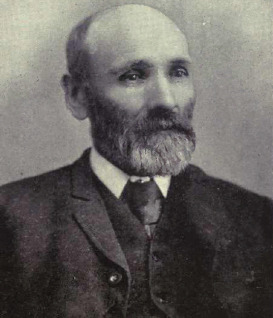
Robert McLaughlin portrait reproduced from the live History page.
Four Corners, Simcoe Street and Mary Street connect the source’s accounts of settlement, commerce and manufacturing. The harbour and railway links helped shape the industrial community, while the carriage works changed location as the business grew.
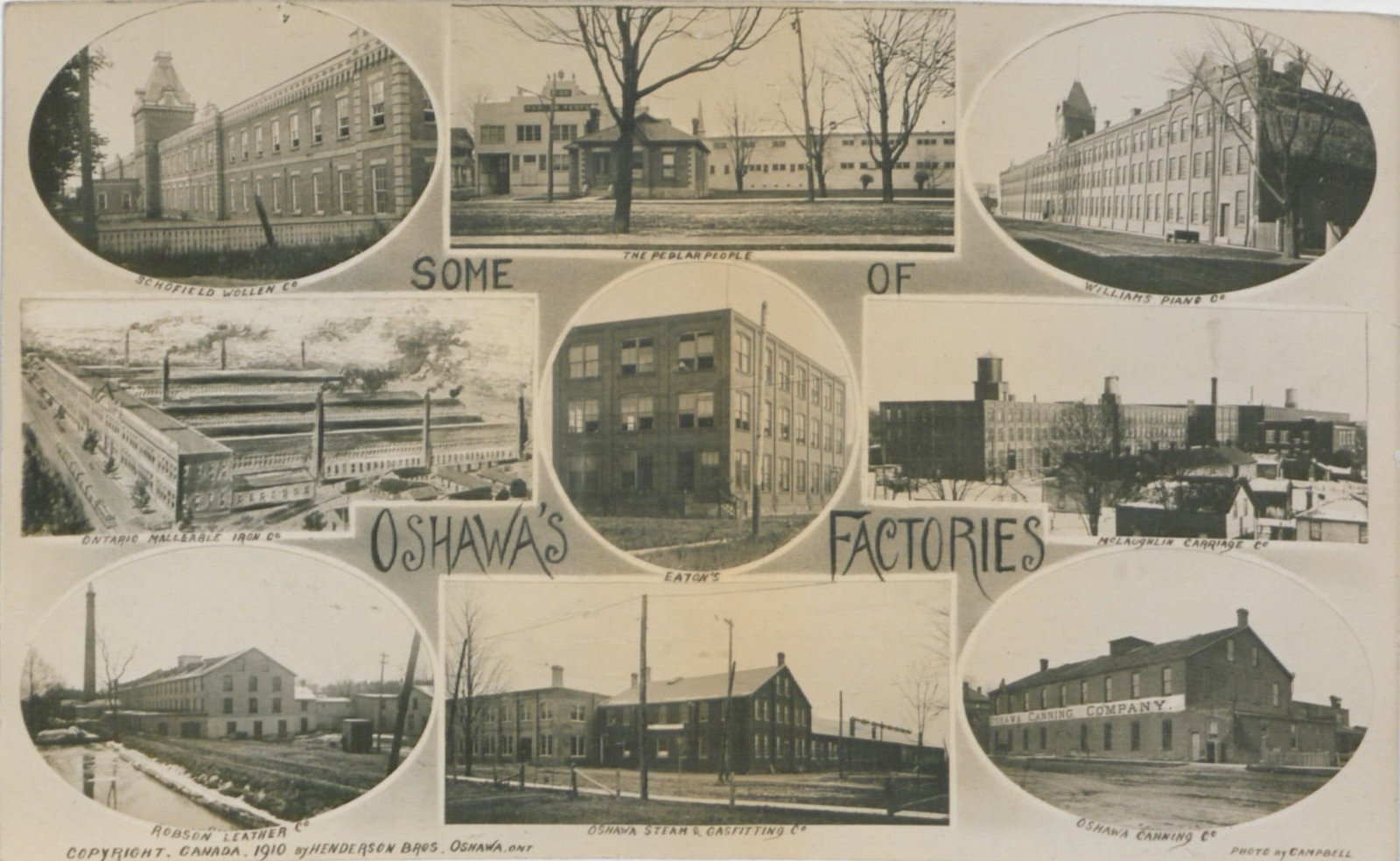
Oshawa factories, 1910 — caption from the live History page.
From industrial centre to a mixed-use downtown
The reference describes downtown as an Urban Growth Centre within Ontario’s Places to Grow initiative. Its account highlights entertainment and sport at Regent Theatre and Tribute Communities Centre, and culture at The Robert McLaughlin Gallery and Canadian Automotive Museum. It also describes restaurants and cafés, regional innovation facilities, start-up spaces and co-working offices.
The source gives undated figures of more than 5,000 downtown workers, more than 2,400 university students and over 50 restaurants and cafés. These are historical reference figures, not verified current counts.
About this historical account
Content and photographs were recovered from the live History page’s public WordPress record because its public page currently displays a broken template placeholder. The account covers Oshawa broadly as well as downtown. Its attribution “Robert Samuel McLaughlin, Sr.” for the 1878 carriage-works move needs historical review; this page avoids repeating that uncertain personal attribution. The source’s unsupported footnote marker [17] has not been presented as a citation. Its modern regional locator map is not used as a historical photograph.